If you wear a ring or a watch to bed, you may have noticed a monthly pattern the app never explains: a week or so before your period, your resting heart rate sits a few beats higher, your temperature reads warmer, your "readiness" or "recovery" score dips, and you are told to take it easy. Nothing is wrong. The luteal phase changes sleep — measurably — and a wearable that scores you against a 24-hour baseline will misread the second half of every cycle as a problem.
This article explains what changes after ovulation, what a wearable actually measures, and how to read sleep and recovery in the context of your cycle instead of against a flat average.
What changes after ovulation
After ovulation, progesterone rises and stays elevated until just before the next period. Two well-documented effects follow.
Core body temperature rises. By a fraction of a degree, and it stays up through the luteal phase, falling again at the start of the next period. This is the basis of basal-body-temperature charting, and it is also why nights feel warmer and why a wearable's skin-temperature trend climbs in the second half of the cycle (Baker & Driver, 2007).
Sleep architecture shifts. Reviews of the sleep literature describe the luteal phase as bringing more awakenings, less rapid-eye-movement sleep and more of the lighter stages in many women, with the effect strongest in the days just before menstruation — and considerably stronger in those with premenstrual symptoms (Baker & Lee, 2018). Subjective sleep quality tends to be worst in the late luteal and first days of menstruation.
Resting pulse rises. Wearable data from thousands of nights shows resting pulse rate climbing after ovulation and staying elevated through the luteal phase, by a few beats per minute — a signal reliable enough that researchers have used it to estimate the fertile window (Shilaih et al., 2017).
None of this is a recovery deficit. It is the same physiology that has been charted with a thermometer for decades, now visible on a wrist.
Why a wearable's score gets it wrong
Recovery and readiness scores are built the same way across brands: tonight's resting heart rate, heart-rate variability and temperature are compared with your rolling baseline, and a deviation lowers the score. That baseline is a flat average of the last few weeks. For anyone who menstruates, the average sits between two different states — a follicular half and a luteal half — so every luteal night looks like a deviation and every follicular night looks like a recovery. The score oscillates with the cycle, and the app narrates it as fatigue, stress or overtraining.
The information is real; the interpretation is missing its context. A luteal-phase pulse three beats above your monthly average is your normal luteal pulse. A luteal-phase pulse three beats above your luteal average is worth noticing.
How long the luteal phase is — and why that helps
The luteal phase is the stable half of the cycle: roughly twelve to fourteen days in most people, and far less variable than the follicular phase, which stretches and shortens from cycle to cycle (Fehring et al., 2006). That stability is what makes cycle-aware reading possible. Once your periods are logged, the days before each one can be identified reliably, and sleep, pulse and temperature from those days can be compared with the same days in previous cycles — like with like.
What to do with the pattern
- Expect it. A warmer, lighter week before a period is a rhythm, not a failure. Plan the hardest training and the earliest mornings for the follicular half where you can.
- Watch the comparison that matters. This luteal phase against the last three luteal phases, not against the month's average.
- Log symptoms with dates. Night sweats, waking, low mood: counted by phase, a pattern becomes visible and a clinician can act on it. Persistent, severe premenstrual sleep disruption or mood change is a reason to talk to someone — it has names and treatments a clinician can discuss.
- Bring it to the appointment. "My sleep falls apart for the week before every period" is a precise, useful sentence when the data behind it is on one page.
How AuraShield does this
- The cycle-metabolic read anchors patterns to the periods you logged, not to a predicted phase, and compares the week before each period with your own average — for energy, mood, appetite and, if you connect a wearable or log it, sleep. Why cycle and metabolism belong in one view.
- Symptoms are counted by phase, so "poor sleep, mostly luteal" is a line on your report rather than a feeling.
- Recovery is its own section: a read on sleep, stress and burnout after about a week of logging, with no wearable required — and with a wearable, the same read in cycle context.
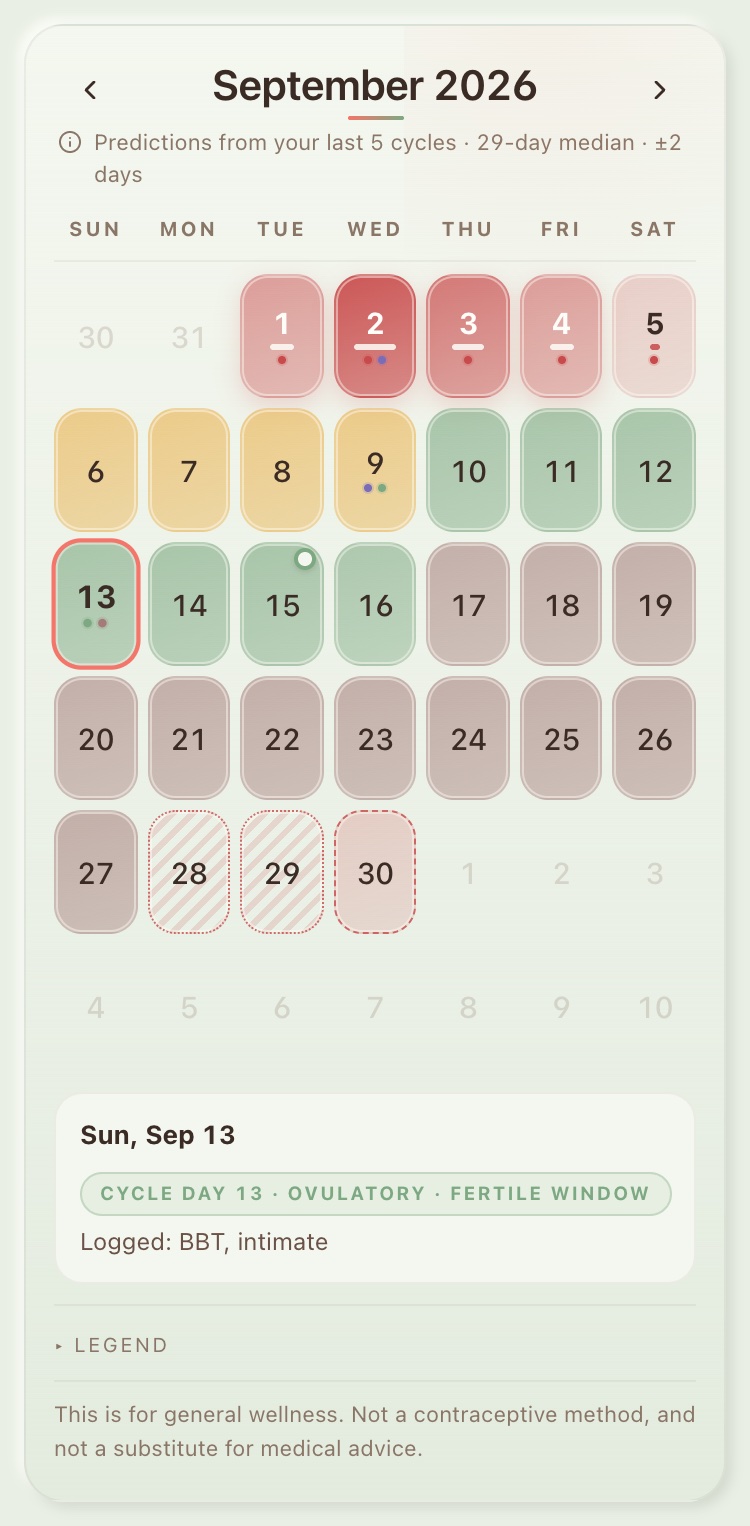
- The calendar's predictions show their confidence, so you know which days the app is sure about. Why a prediction should show how sure it is.
- All of it on the free plan, with your cycle data encrypted field by field and our cycle-data policy public.
What this is not
A cycle-aware read of sleep does not diagnose anything, and it does not replace a sleep study, a thyroid test or a conversation about mood. Loud snoring with daytime sleepiness, sleep that is broken every night of the month, or mood changes that frighten you are reasons to see a clinician regardless of the calendar.
FAQ
My wearable says I'm "unrecovered" every month before my period. Is it broken?
No — it is measuring real physiology: a higher resting pulse, a warmer night, lighter sleep. What it lacks is the cycle context to say that this is your normal luteal state. Read the luteal week against previous luteal weeks and the picture usually settles.
Can the app use my wearable's temperature to confirm ovulation?
AuraShield records basal body temperature you log and shows it on the cycle timeline, and it labels ovulation predicted, counted back from your luteal length. It does not claim to confirm ovulation from a wearable, and it is not a contraceptive method.
Does progesterone cause the warmer nights?
The rise in core temperature after ovulation is associated with the luteal rise in progesterone; the reviews cited above describe the mechanism. For the purposes of reading your data, what matters is that the pattern is expected and repeats with the cycle.
This article is general health information, not medical advice, and AuraShield is a general-wellness product, not a medical device. It screens, educates and refers; it does not diagnose. For anything about your own health, talk to a clinician who can examine you.