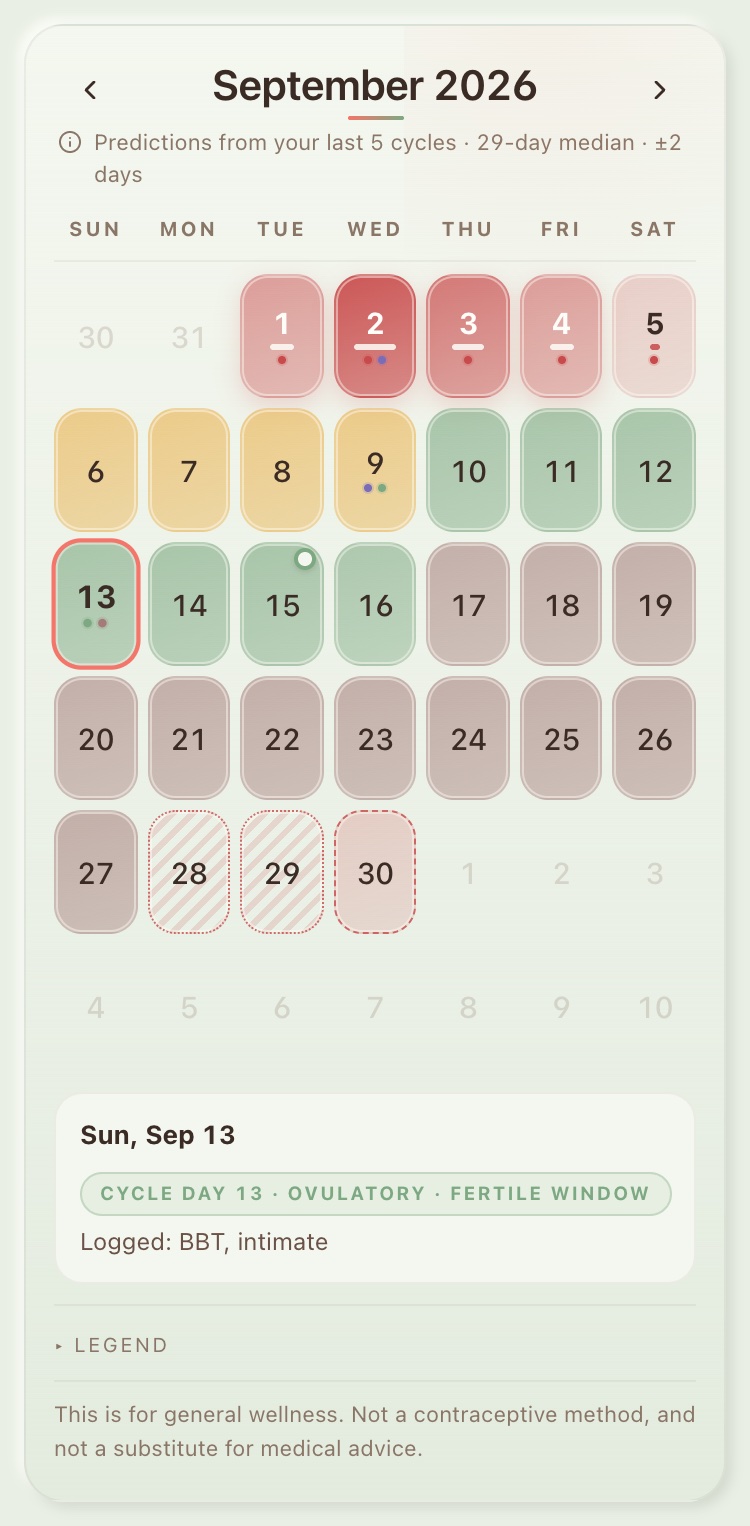
Open most period apps and the next period sits on the calendar as a single day, drawn with the same confidence as a dentist's appointment. Behind that day is an estimate, and estimates have error bars. A period prediction with a confidence band shows you the estimate and the error — and it turns out that the honest version is also the more useful one.
This article explains how AuraShield's cycle calendar predicts, why the band widens the further out you look, and why the prediction is anchored to the periods you actually logged rather than to a 28-day textbook.
Where "28 days" came from, and why it misleads
Twenty-eight days is an average, and averages hide spread. In the largest published analysis of real-world cycles — more than 600,000 of them — the typical cycle was a little longer than 28 days, and the spread between cycles was wide even for the same person (Bull et al., 2019). Clinical definitions reflect that: the international FIGO classification treats 24 to 38 days as the normal range for cycle length in adults, with cycle-to-cycle variation of up to seven to nine days still considered normal (Munro et al., 2018). For adolescents the normal range is wider still (ACOG, 2015).
An app that predicts your next period from "28 days" is predicting an average person. An app that predicts from your last cycles is predicting you — and can also tell you how consistent you have been, which is exactly what the confidence band expresses.
How the prediction is built
AuraShield's calendar works in three steps.
1. It anchors to logged periods, not guesses. Each period you log — or each run of bleed days you record — is a fixed point. Nothing in the prediction moves a point you logged.
2. It uses your own median cycle length. Once you have logged at least three cycles, the app uses the median length of your recent cycles rather than the profile setting you typed at sign-up. The median is deliberately chosen over the mean: one unusually long or short cycle (travel, illness, a late-logged period) should not drag every future prediction with it. Until three cycles are logged, the app says plainly that it is using your setting.
3. It projects three cycles ahead and widens the band each time. The next period is predicted as the last logged start plus your median length. The band around that date comes from how much your cycles have varied: consistent cycles give a narrow band, variable cycles a wide one. Each further cycle out multiplies the uncertainty, because a small error in one cycle becomes the starting point for the next — so the second and third predicted periods carry wider bands and lower confidence than the first, and the calendar draws them that way.
A prediction that looks the same three cycles out as it does next week is not confident. It is just not telling you.
What the band is made of
The band is not decoration. On a well-logged, regular history it might read "±2 days"; on a history of five variable cycles it might read "±5 days". Two things move it:
- How many cycles you have logged. Fewer cycles, less evidence, wider band.
- How much those cycles varied. The app measures the spread of your recent cycle lengths and sizes the band from it.
Both are shown in the calendar's caption — for example, "Predictions from your last 5 cycles · 29-day median · ±2 days" — so the number and its basis are never separated.
The luteal phase is the stable half
Ovulation is not "day 14". Research on cycle phases consistently finds that the second half of the cycle, the luteal phase, holds fairly constant in length, while the first half varies (Fehring et al., 2006). That is why AuraShield counts ovulation backwards from the predicted next period using your luteal length, rather than forwards from day one. On a 35-day cycle, counting forward puts "ovulation" more than a week too early; counting backward puts it where the physiology suggests.
The calendar labels the resulting days predicted, and it never says "you are ovulating". A prediction is a prediction.
What happens when your data changes
- Log a period late and the calendar re-anchors from the real start date. Predictions move; nothing you logged does.
- Correct a wrong date — a period logged on the wrong day, a start that was really the 14th — by editing it, and everything downstream re-derives. The AI coach can make the same edit for you, and it will always say which date it is changing and why: phases are calculated from period dates, never set directly.
- Go quiet for a cycle and the app pauses predictions rather than inventing a phase for day 61 of a 28-day cycle. It says why, and tells you how many days it has been since your last logged period.
How AuraShield does this
- A served calendar: the phase for every day is computed on the server by one engine, and every part of the app — the calendar, the daily view, the coach — reads the same numbers.
- Three cycles ahead, bands that widen, with the number of cycles and the median length printed on the calendar.
- Anchored to your logged periods, with a median that resists outliers.
- Predicted ovulation counted back from your luteal length.
- Symptoms counted by phase, so a pattern shows as a pattern, and everything lands on the doctor's report.
The calendar is on the free plan. Cycle data is encrypted field by field and our cycle-data policy is public — including what we will and will not disclose.
What it is not
A prediction with a confidence band is still a prediction. It is not a contraceptive method, it is not a fertility diagnosis, and a cycle that regularly falls outside the 24–38-day range — or 90 days without a period — is a reason to see a clinician, whatever the calendar says.
FAQ
How many cycles do I need to log before predictions are personal?
Three. Until then the calendar uses the cycle length you set up and says so in its caption. From three logged cycles it switches to your own median, and the band starts reflecting your consistency.
Why does the third predicted period have a wider band than the first?
Because each prediction starts from the previous one. A small error in the first predicted start becomes the starting point for the second, and the second for the third. The band grows to reflect that, and the calendar draws it that way rather than pretending all three are equally certain.
Can the AI coach change my phase dates?
No — and it will not claim to. Phases are derived from your period dates and your cycle and luteal lengths. What the coach can do, with your confirmation on each change, is edit a period's start or end date or your cycle settings; the phases then follow.
This article is general health information, not medical advice, and AuraShield is a general-wellness product, not a medical device. It screens, educates and refers; it does not diagnose. For anything about your own health, talk to a clinician who can examine you.