You have tracked for months: periods, symptoms, a lab panel, a few weeks of blood pressure. You bring your phone to the appointment, open the app, and start scrolling. The clinician glances, nods, and asks a question you already answered on screen three. The problem is not your data. It is that clinicians read in a fixed order under a fixed time limit, and a scrolling app fits neither. A one-page health summary for your doctor — organised the way they read — is the single most effective thing self-tracked data can become.
This article explains what belongs on that page, in what order, and how AuraShield generates it.
The two constraints every appointment has
Time. A systematic review across 67 countries found primary-care consultations average about five minutes in half the world, and roughly twenty in the countries with the longest visits (Irving et al., 2017). Whatever you bring has to be read inside that.
Attention. In a study of recorded clinical encounters, clinicians who did invite the patient's agenda interrupted it after a median of eleven seconds (Singh Ospina et al., 2019). The first sentence on your page has to be the thing you came about.
Together these say: one page, your concern first, the rest ordered by what a clinician would act on.
The order clinicians expect
Two published standards describe how a patient summary should be organised — the international patient summary used for cross-border care (HL7 FHIR IPS) and the UK's outpatient letter standard (PRSB). They disagree on details and agree on the skeleton:
- Who the patient is — name, date of birth, sex.
- The patient's concern, in the patient's own words.
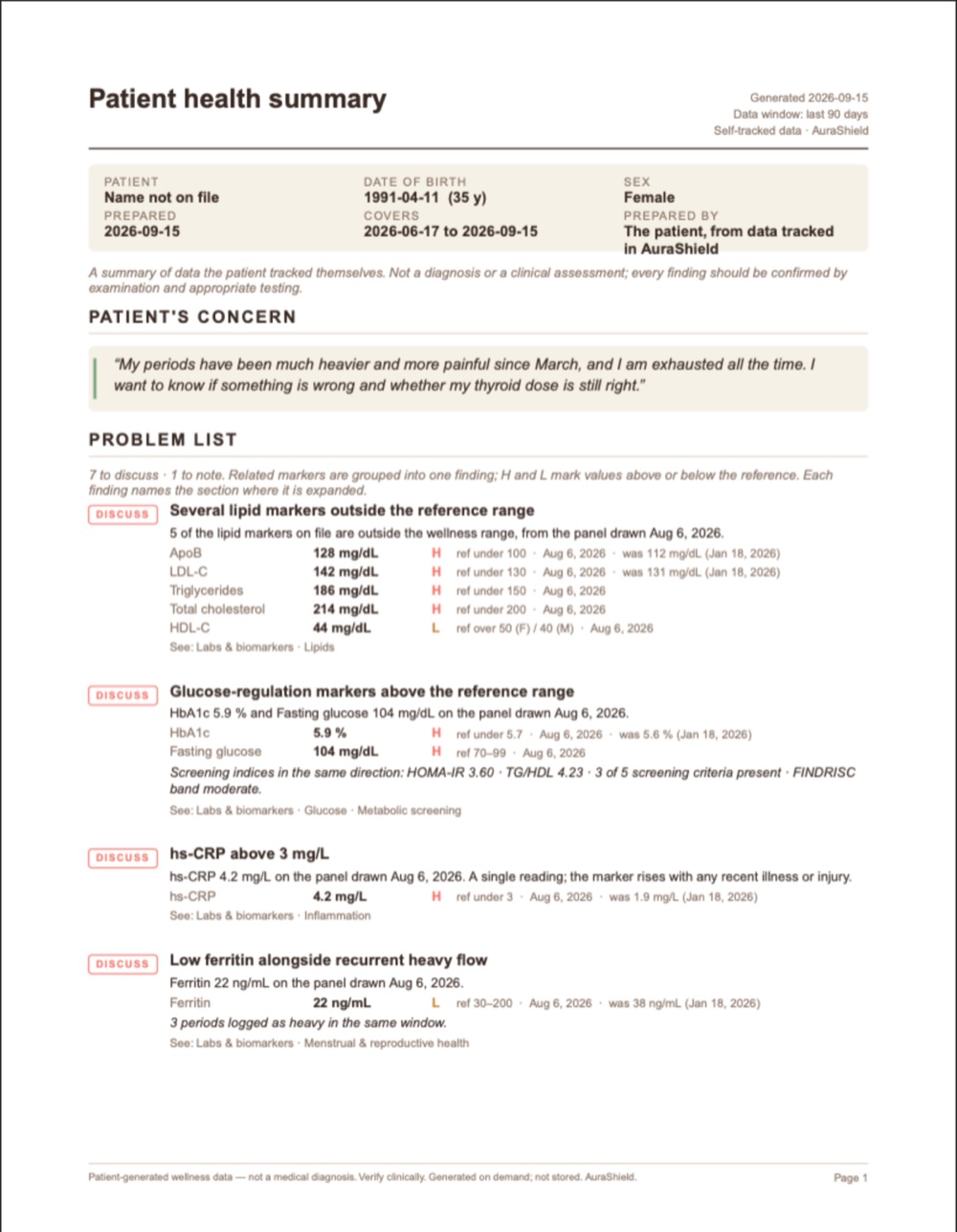
- The problem list — findings, not measurements, ordered by what needs discussing.
- Allergies and adverse reactions — always present, even if the answer is "none known".
- Medications — with dose and frequency, including supplements and contraception.
- The evidence — the data each finding rests on, with dates.
AuraShield's report follows that order because the standards do, not because it looks tidy.
What a "finding" is, and why it beats a list of numbers
A page of lab values with reference ranges is a list of measurements. A finding is what those measurements say together. Five lipid values that are each slightly off are one finding — several lipid markers outside the reference range — with five lines of evidence under it. A low ferritin next to three periods logged as heavy is one finding that says both, because that is the conversation a clinician will actually have.
A measurement asks the doctor to do the thinking in the eleven seconds they have. A finding shows the thinking and lets them check it.
Each finding on the report carries a tier — discuss or note — set by published thresholds, never by a model. Under it, every line of evidence shows the value, the reference used, the date of the draw, and, where you have one, the previous draw. A number without its date and denominator is an opinion; the report does not print opinions.
One HbA1c is a snapshot. Two, a year apart, are a direction. When a marker has been measured more than once, the report says so on the finding itself — 5.9 % · was 5.6 % (Jan 18, 2026) — and a Trends table in the appendix lists every repeated marker with its earliest and latest value, the change, and what the line is based on. Home blood pressure and weight are shown as monthly means, because one reading is a mood and a month is a pattern. A change smaller than a marker's usual variation is labelled flat rather than dressed up as a trend.
What the cycle adds
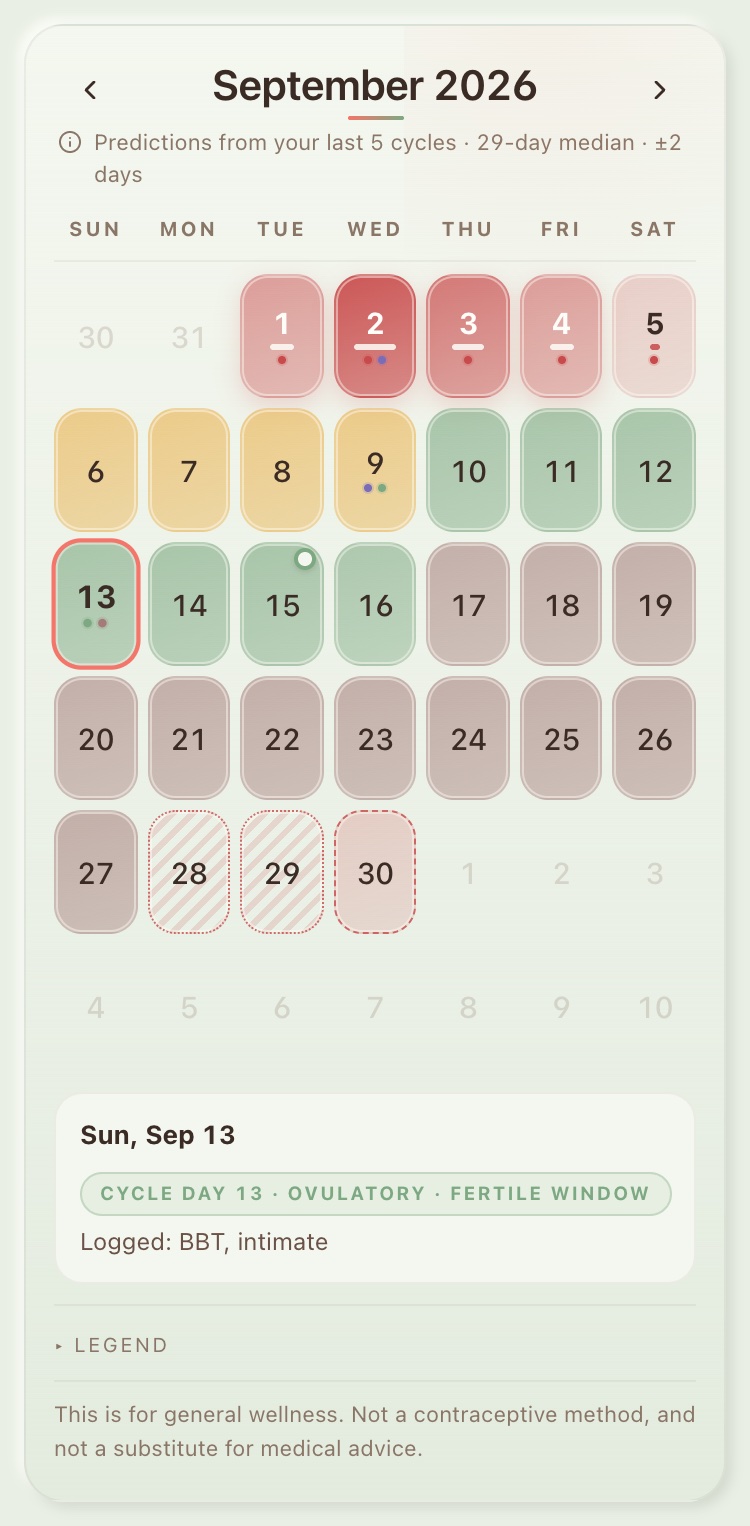
For anyone who menstruates, the same page carries a compact cycle section: the last period, the median cycle length and its spread, the cycle history, and symptoms counted by phase — so "headaches, mostly in the luteal phase, five of six logs" is a line on the page rather than something you try to remember to say. Hormone labs carry the cycle day of the draw, without which they are close to uninterpretable. Why cycle and metabolic data belong in one view.
What the report deliberately does not do
- It does not diagnose. Every page says so, and the language is checked against a list of diagnostic and disease terms before it is printed.
- It does not invent a number. If the app has one reading, the page says 1 reading, never average.
- It does not claim completeness. The medication list is what you recorded; the page says it is not reconciled with a pharmacy record.
- It is not stored. The PDF is generated when you ask for it and handed to you; nothing about the export is kept beyond an entry in your own audit log.
How AuraShield does this
- Export from the cycle page, choose the sections (cycle, vitals, labs, metabolic screening), and type the concern you want the clinician to see first. The concern is printed verbatim at the top.
- Findings, not measurements: related markers grouped, tiered by published thresholds, each with its evidence and its previous draw.
- Allergies and medications the way a prescriber reads them — an explicit no known allergies is recorded as a statement with its date, which is different from never having been asked.
- Trends across draws, symptoms by cycle phase, labs by panel in the appendix, every value with its denominator.
- Free on every plan. See the report on the home page or compare plans.
How to use it in the room
Print it, or hand over your phone with the PDF open. Say the concern in one sentence — it is the first thing on the page. Let the clinician read the problem list; it takes about a minute. Then ask what they would check next. You will have spent your eleven seconds on the thing you came about, and the rest of the visit on the answer.
FAQ
Do I need labs for the report to be useful?
No. With cycle data alone the report carries the concern, the cycle history, symptoms by phase and any cycle findings — which for many appointments is the whole point. Labs and home readings add the metabolic and trend sections when you have them.
Can I choose what the report includes?
Yes. The cycle, vitals, labs and metabolic sections are each optional, and a section you leave out is left out entirely — including any finding that would only exist because of it. Contraception and HRT appear only when the cycle section is included.
Is my data stored when I export?
No. The report is generated on demand from your account and delivered to you. The export itself is recorded in your cycle audit log, so you can see when reports were made and by whom.
This article is general health information, not medical advice, and AuraShield is a general-wellness product, not a medical device. It screens, educates and refers; it does not diagnose. For anything about your own health, talk to a clinician who can examine you.