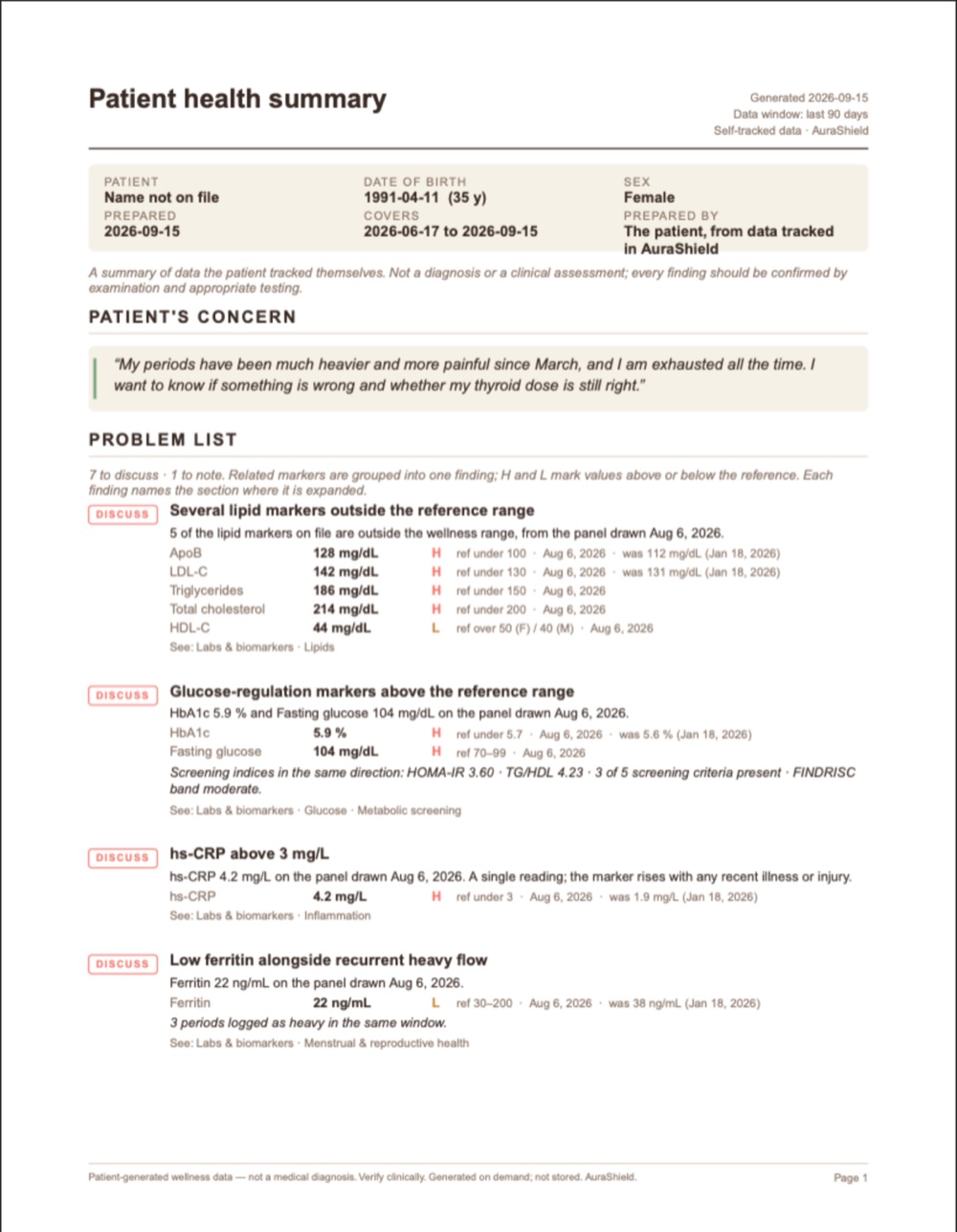
Tired all the time, periods that have got heavier, and a ferritin result that came back "low" on a panel you had for another reason. Each of those on its own is easy to wave away. Together, heavy periods and low ferritin are one of the most common — and most under-reported — patterns in women's health, and one where your own tracked data can change the quality of an appointment.
This article explains what "heavy" means in clinical terms, what a ferritin value does and does not tell you, and how AuraShield puts the two on one page as a single finding.
What counts as heavy?
Clinicians do not measure heaviness in millilitres in the consulting room; guidelines define heavy menstrual bleeding by its effect on your life. The UK's NICE guideline describes it as excessive blood loss that interferes with physical, emotional, social and material quality of life (NICE NG88). The international FIGO classification treats bleeding that lasts more than eight days, or that the patient reports as heavy, as outside the normal range (Munro et al., 2018).
Practical signs clinicians ask about: soaking through a pad or tampon every hour for several hours in a row, needing double protection, passing clots larger than a coin, bleeding for more than a week, or planning your life around your period. If any of those is familiar, "heavy" is a fair word — and a period tracker that lets you log flow as heavy on the day is more reliable than trying to remember three months later.
What ferritin is — and is not
Ferritin is the protein that stores iron, and a blood ferritin level is the standard first look at your iron stores. The World Health Organization's 2020 guideline uses a ferritin below 15 µg/L to define iron deficiency in otherwise healthy adults, and notes that ferritin rises with inflammation and infection, which can hide a deficiency (WHO, 2020). Many clinicians use a higher working threshold — around 30 µg/L is common in practice — because symptoms often appear before stores are fully exhausted. AuraShield uses 30 as its wellness reference and says so beside the value.
Two things a single ferritin cannot tell you: why it is low, and whether it is falling. The first needs a clinician. The second needs a second draw — which is why the report shows the previous value next to the current one whenever you have it.
Low ferritin is a finding. Heavy periods are a finding. Low ferritin alongside heavy periods is a different conversation, and it is the conversation worth having.
Why the two belong on one line
Heavy menstrual bleeding is a leading cause of iron deficiency in women of reproductive age, which is why NICE's guidance on heavy bleeding includes checking for anaemia (NICE NG88). In practice, though, the two facts often live in different places: the bleeding in your memory, the ferritin in a lab portal. A clinician who sees only the ferritin may look for other causes first; one who sees only the bleeding may not think to check iron.
AuraShield's doctor's report links them explicitly. When your labs include a ferritin below the reference and your cycle history includes repeated periods logged as heavy, the report presents a single finding — low ferritin alongside recurrent heavy flow — with the ferritin value, its reference and date, the previous draw if there is one, and the number of periods logged as heavy in the same window. It is tiered discuss, and it names the section of the report where each half is expanded.
What your own data can honestly show
- A pattern of heavy days, logged when they happened, across several cycles.
- Cycle and bleed length from your logged periods, against the normal ranges.
- A ferritin value with its reference and date, and its direction if you have two.
- Symptoms counted by phase — fatigue that clusters around your period reads differently from fatigue spread across the month.
What only a clinician can tell you
Whether the bleeding has a cause that needs treating, whether you are anaemic (that is a haemoglobin question, not a ferritin one), whether iron supplementation is right for you and at what dose, and whether anything else in the picture matters. The app's job is to make sure the clinician sees the whole picture in the first minute; it does not diagnose and it does not recommend a dose.
How AuraShield does this
- Log flow on the day — spotting, light, medium or heavy — in the calendar or by asking the coach.
- Enter or upload labs once; ferritin sits in the Iron & vitamins panel with its reference and the cycle day of the draw where your history supports it.
- The report links the two into one finding, with evidence and dates, and prints the concern you typed at the top — "my periods have been heavier since March and I'm exhausted" is exactly the sentence a clinician wants first. What the one-page report contains.
- Everything above is on the free plan. Your cycle data is encrypted field by field; our cycle-data policy is public.
When not to wait for an appointment
Bleeding that soaks through protection every hour for more than two hours, dizziness or fainting, chest pain or breathlessness with heavy bleeding — these are reasons to seek urgent care, not to log and wait. The report is for the planned appointment; it is not a triage tool.
FAQ
My ferritin is "normal" on the lab's range but I still feel exhausted. Is the app wrong to flag it?
Lab reference ranges for ferritin vary, and some start as low as 10–15 µg/L. AuraShield uses 30 as a wellness reference, which is why a value the lab calls normal may be marked L in the app, with the reference printed beside it. Neither the lab nor the app is diagnosing you; the value and the symptom together are a question for your clinician.
How many heavy periods before the report links them to ferritin?
Two or more periods logged as heavy in the report's window produce the recurrent heavy flow flag; when a ferritin below the reference exists in the same window, the report presents the two as one finding.
Does the app tell me to take iron?
No. It presents the finding and the evidence. Whether to supplement, and how much, is a decision for a clinician who can check your haemoglobin and look for the cause.
This article is general health information, not medical advice, and AuraShield is a general-wellness product, not a medical device. It screens, educates and refers; it does not diagnose. For anything about your own health, talk to a clinician who can examine you.