Two tests measure "blood sugar" and they are not the same thing. HbA1c vs fasting glucose is one of the most searched lab questions for a reason: a panel often reports both, they can point in different directions, and the ranges printed beside them are not always the ones clinicians use. Understanding what each test measures — and what makes each one wrong — turns two numbers into a question worth asking.
This guide explains both tests, the classification ranges from the American Diabetes Association and the WHO, the things that quietly distort HbA1c, and how AuraShield shows the two side by side with their dates.
Fasting glucose: one morning
Fasting plasma glucose is the concentration of glucose in your blood after at least eight hours without food. It is fast, cheap and standard, and it tells you about one moment. It is affected by the night before, by stress and illness, by how long you actually fasted, and by the day-to-day variation every biological measurement has.
The ADA places a fasting glucose of 100–125 mg/dL in the prediabetes range and 126 mg/dL or above in the diabetes range, with the caution that any diagnosis needs confirmation — a repeat test, or a second test of a different kind — and clinical judgement (ADA Standards of Care, 2024).
HbA1c: roughly three months
Glucose attaches to haemoglobin in red blood cells, and the proportion of haemoglobin that carries it — HbA1c — reflects average glucose over the life of those cells, roughly the preceding two to three months. It does not need fasting, it is less affected by a single bad day, and it is why clinicians use it to follow glucose over time.
The ADA classification puts 5.7–6.4% in the prediabetes range and 6.5% or above in the diabetes range (ADA, 2024); the WHO endorsed 6.5% as a diagnostic threshold in 2011 while noting that a value below it does not exclude diabetes and that the test has to be run in a standardised, quality-assured lab (WHO, 2011).
Fasting glucose is a photograph. HbA1c is a three-month average. A photograph can be unlucky; an average can be quietly biased. That is why the honest answer to "which one?" is usually both.
What makes HbA1c wrong
Because HbA1c depends on red blood cells, anything that changes how long those cells live or how much haemoglobin they carry changes the number without changing your glucose. The NGSP, which standardises the test, keeps a list of interfering factors (NGSP). The ones that matter most in a women's-health context:
- Iron-deficiency anaemia tends to raise HbA1c — older red cells accumulate more glucose. If your ferritin is low, your HbA1c may read high for reasons that have nothing to do with sugar. See heavy periods and low ferritin.
- Recent blood loss, treated anaemia or a recent transfusion tend to lower it — a fresh population of red cells has had less time to pick up glucose.
- Haemoglobin variants (such as sickle-cell trait) can interfere with some assay methods; the NGSP lists which methods are affected.
- Pregnancy shifts red-cell turnover; HbA1c is not the test used for gestational diabetes.
- Kidney disease and some medications can also shift it.
None of this makes HbA1c a bad test. It makes it a test with a context — and a fasting glucose, or an oral glucose tolerance test, is the check that does not share the same blind spots.
Reading the two together
| Fasting glucose | HbA1c | What a clinician tends to think |
|---|
| Normal | Normal | Nothing to chase; repeat at the usual interval |
| High | High | Two tests agree; confirm and discuss |
| Normal | High | Is HbA1c being pushed up — iron deficiency, a variant? Or is glucose rising after meals but not fasting? |
| High | Normal | A single unlucky morning, or an early change fasting picks up first — repeat |
The table is not a diagnosis; it is the shape of the conversation. What makes the conversation short is having both numbers, their dates, and — if you have it — a ferritin next to them.
The third number: what fasting glucose can do with triglycerides
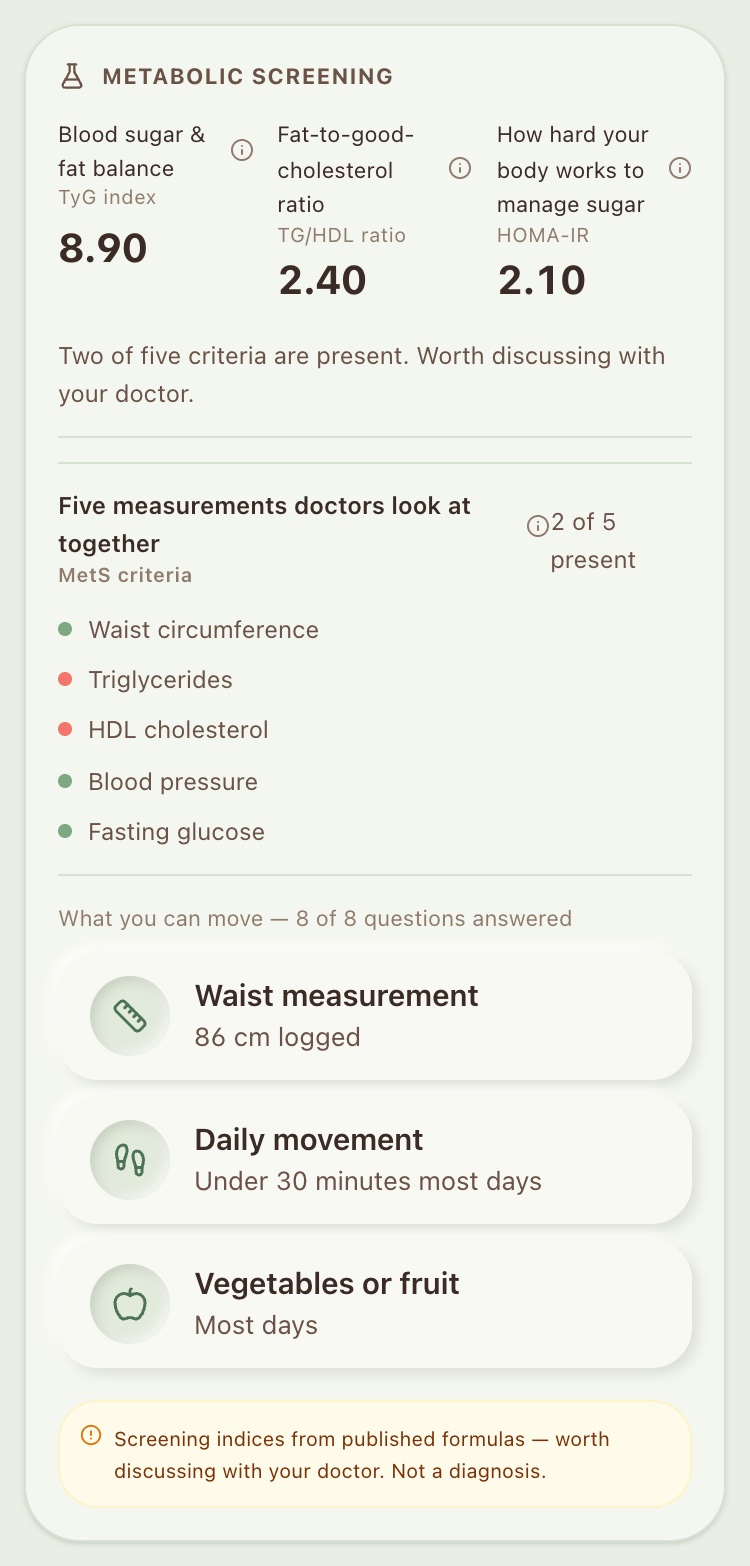
A fasting glucose on the same panel as fasting triglycerides lets you compute the TyG index, a published surrogate for insulin resistance (Simental-Mendía et al., 2008). It is not a replacement for either test above; it is one more screen from values you already have — how to read the labs you already have explains it, and the FINDRISC questionnaire is the two-minute first read when you have no panel at all.
How AuraShield does this
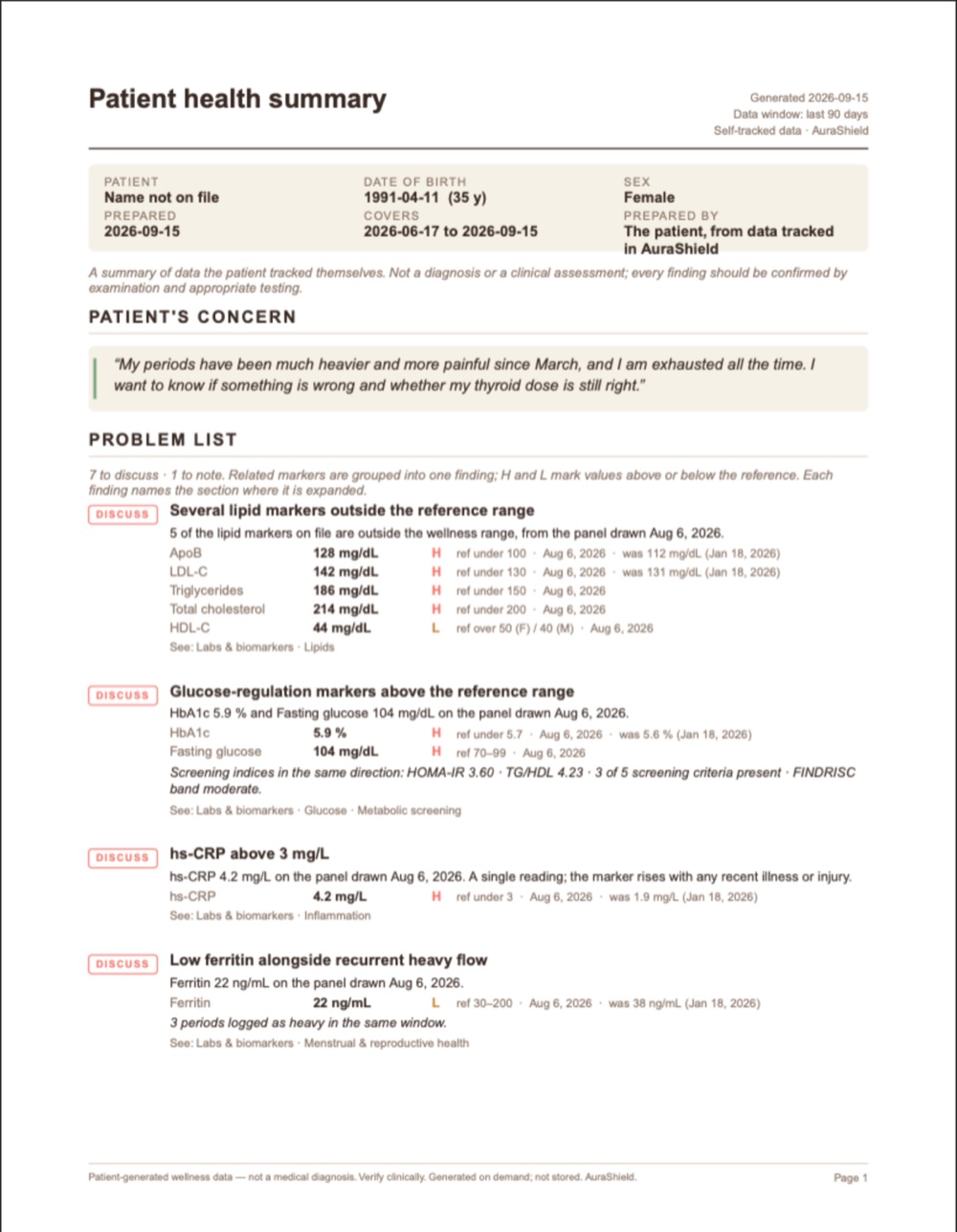
- Enter both tests with the date of the draw; each shows its reference range beside the value, and a second draw shows the previous value and the direction.
- Ferritin sits in the same view, in the Iron & vitamins panel, so a low ferritin next to a high HbA1c is visible on the same page rather than in two portals.
- The screening indices — TyG, TG/HDL, HOMA-IR when fasting insulin exists — are computed automatically, and a missing input is said out loud.
- The doctor's report groups glucose-regulation findings as one item with its evidence, dates and previous draws, and a Trends table shows HbA1c across draws. What the one-page report contains. Free on every plan.
Reference ranges and formulas are on the methodology page, with sources.
What to ask for
If you have only one of the two, ask for the other at the next draw. If HbA1c is high and you menstruate heavily, ask for a ferritin with it. If the two disagree, that disagreement is the question — bring both numbers, with dates, and let the clinician decide whether the next test is a repeat, an oral glucose tolerance test, or nothing at all.
FAQ
My HbA1c is 5.8% but my fasting glucose is normal. Do I have prediabetes?
That combination is one a clinician looks at rather than one an app should label. Iron deficiency and some other factors can raise HbA1c independently of glucose, and post-meal glucose can rise before fasting glucose does. It is a reason for a conversation and, usually, a repeat or a second kind of test — not a diagnosis on its own.
Does the app convert mmol/L to mg/dL, or mmol/mol to percent?
Yes. Enter the value in the unit on your report; AuraShield converts to a single canonical unit for comparison and shows which unit you entered, so a draw in one unit and a draw in another sit on the same line.
How often should these be repeated?
That is your clinician's call and depends on the result. The app's job is to keep every result with its date so that, when you repeat a test, the direction is visible rather than remembered.
This article is general health information, not medical advice, and AuraShield is a general-wellness product, not a medical device. It screens, educates and refers; it does not diagnose. For anything about your own health, talk to a clinician who can examine you.