Most people get a blood panel back, glance at the flags, and file it. But a routine panel — fasting glucose, triglycerides, HDL, sometimes fasting insulin — can be combined into a few metabolic screening indices that researchers use to spot insulin resistance and metabolic risk earlier than any single value does. None of them is a diagnosis. All of them are worth understanding, because they turn a page of numbers into a question you can bring to a clinician.
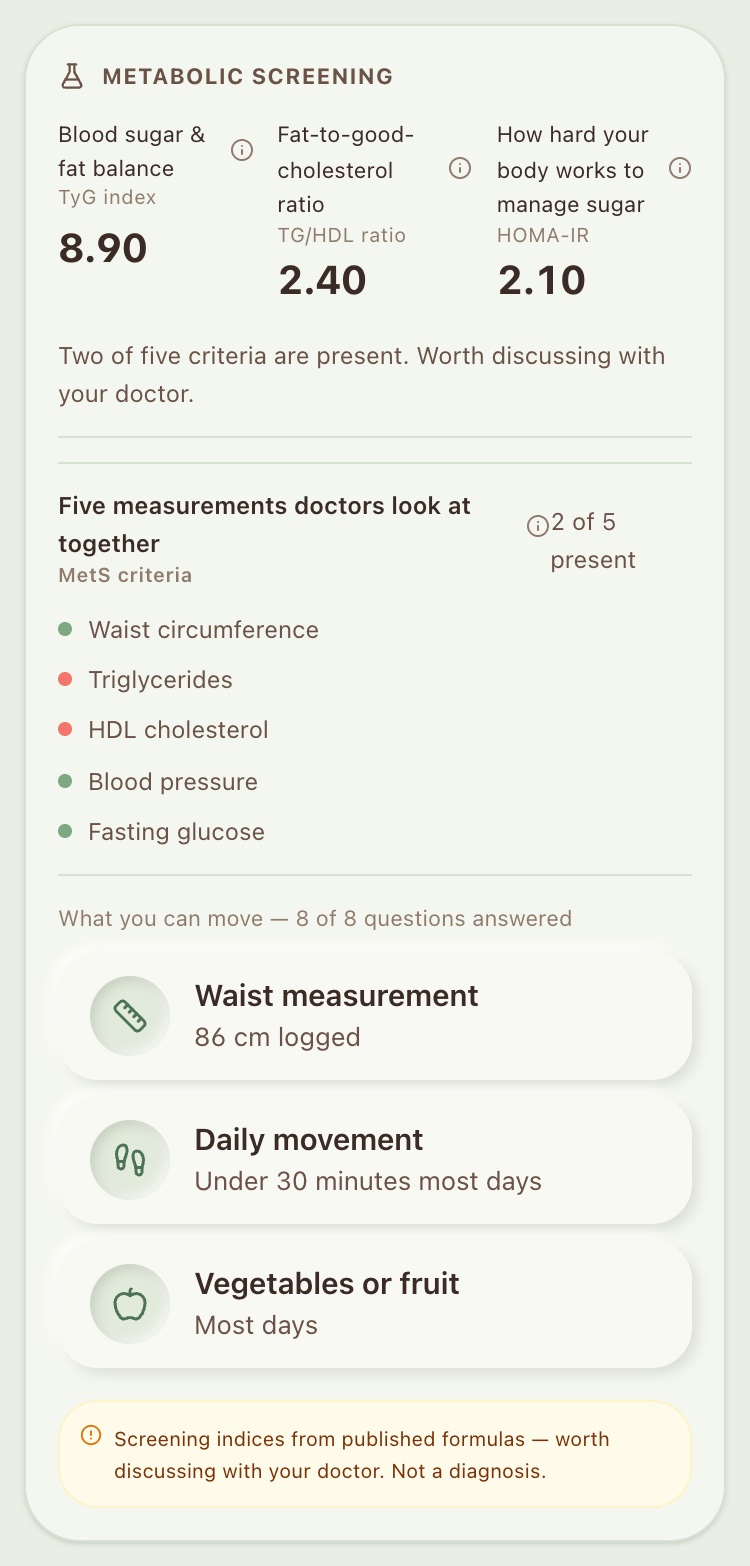
This guide explains the four screens AuraShield computes from labs you already have: the TyG index, the TG/HDL ratio, HOMA-IR, and the five metabolic-syndrome criteria.
First, what a "screen" is
A screen is a rule that says this combination of numbers is worth a closer look. It is deliberately simple, it is built from published research, and it sorts people into "probably fine" and "worth checking" — nothing finer. A diagnosis is a clinician's judgement about you, made with an examination and the tests they choose. Keep the two apart and lab numbers become useful rather than frightening.
The TyG index
The TyG index combines fasting triglycerides and fasting glucose into one number. It was proposed in 2008 as a surrogate marker of insulin resistance in people with no known disease (Simental-Mendía et al., 2008) and has been studied widely since. The formula is:
TyG = ln( fasting triglycerides (mg/dL) × fasting glucose (mg/dL) / 2 )
Typical values in adults sit roughly between 8 and 9.5. Higher means the two markers are drifting upward together — the pattern seen when the body needs more insulin to keep glucose in range. Because it needs only two of the cheapest lab values, TyG is one of the most accessible screens there is.
What it cannot do: it cannot tell you why the number is what it is, and different studies use different cut-offs. Treat it as a direction, not a verdict.
The TG/HDL ratio
Divide triglycerides by HDL cholesterol (both in mg/dL). A ratio comfortably under 2 is usually unremarkable; ratios climbing above 3 are more often seen alongside insulin resistance and the small, dense LDL particles associated with cardiovascular risk. It is crude — HDL varies by sex and ancestry, and triglycerides swing with the last meal — which is why it is read next to the others, never alone.
HOMA-IR
HOMA-IR (Homeostasis Model Assessment of Insulin Resistance) uses fasting glucose and fasting insulin:
HOMA-IR = fasting insulin (µIU/mL) × fasting glucose (mg/dL) / 405
It was published in 1985 (Matthews et al.) and remains the most used research estimate of insulin resistance. Values around 1 are typical of insulin-sensitive adults; commonly quoted screening thresholds sit between 2 and 2.5, though labs and populations differ. The catch is that most routine panels do not include fasting insulin — so HOMA-IR is often the one screen you cannot compute until you ask for it.
If one lab value is worth requesting at your next draw, fasting insulin is a strong candidate. It unlocks HOMA-IR and costs little.
In 2009 several major cardiology and diabetes bodies harmonised a definition of metabolic syndrome (Alberti et al., 2009). It is a checklist of five measurements; meeting three or more is the screening threshold:
| Criterion | Screening threshold (the harmonised statement) |
|---|
| Waist circumference | Population- and country-specific cut-offs |
| Triglycerides | ≥ 150 mg/dL, or treatment for it |
| HDL cholesterol | < 50 mg/dL in women, < 40 mg/dL in men, or treatment for it |
| Blood pressure | ≥ 130 systolic or ≥ 85 diastolic, or treatment for it |
| Fasting glucose | ≥ 100 mg/dL, or treatment for it |
What makes this checklist useful is that each line is something you can measure or already have. What makes it dangerous to misread is that "three of five" is a screening rule from a consensus statement, not a diagnosis of anything about you.
Two more numbers worth knowing
HbA1c reflects average glucose over roughly three months. The American Diabetes Association's classification places 5.7–6.4% in the prediabetes range and ≥ 6.5% in the diabetes range, with the caution that a diagnosis needs confirmation and clinical judgement (ADA Standards of Care, 2024). If you have one HbA1c, the most valuable thing you can add is a second one a few months later — a direction beats a snapshot.
ApoB counts the number of atherogenic lipoprotein particles rather than the cholesterol they carry. A growing body of evidence argues it is a better measure of cardiovascular risk than LDL cholesterol alone (Sniderman et al., 2019). It is not on every panel; when it is, it belongs beside your LDL, not instead of it.
How AuraShield does this
- Enter a panel once (or upload the PDF on Plus) and the app computes TyG, TG/HDL and HOMA-IR where the inputs exist, and shows which of the five criteria it can measure and which are present.
- Missing inputs are said out loud. If fasting insulin is absent, HOMA-IR shows as not measurable — never as a guessed value.
- The numbers are read in the context of your cycle, not against a flat average: see why cycle and metabolism belong in one view.
- Every value carries its reference and its date, and a repeated marker shows the previous draw beside it, so a change reads as a change.
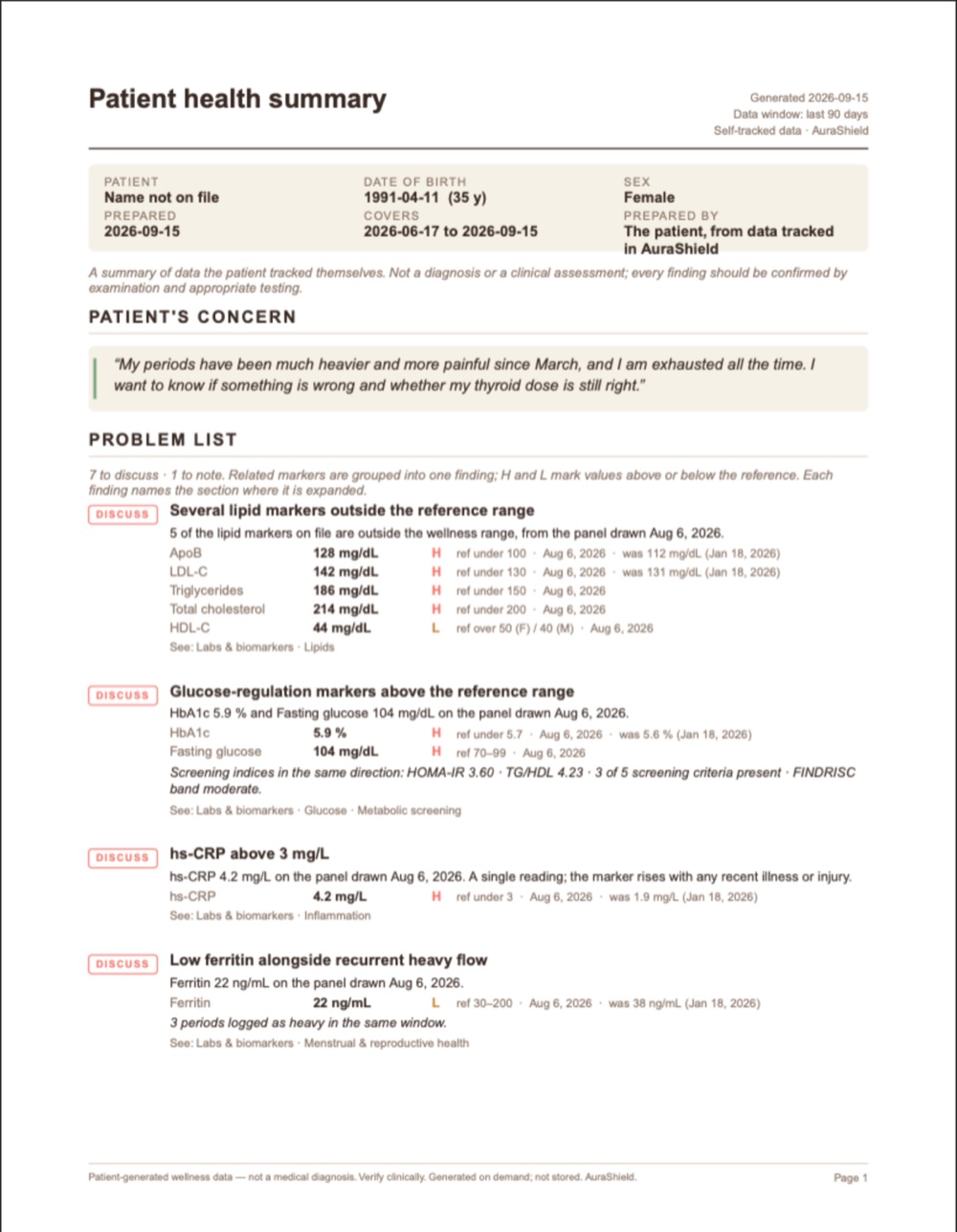
- The result goes on your doctor's report as a finding with its evidence: what the one-page report contains. The report is free on every plan.
Reference ranges used by the app are published on the methodology page, with sources.
What to do with a screen that comes back "worth a look"
Bring it to a clinician, with the numbers it was built from. Ask what they would measure next — often fasting insulin, a repeat panel, or a waist measurement, sometimes nothing at all. A screen's job is to make that conversation happen earlier and with better information; it is not a treatment plan, and AuraShield will never present it as one.
FAQ
Can I calculate the TyG index from a non-fasting panel?
The published formula uses fasting values. A non-fasting triglyceride result can be markedly higher after a meal, so a TyG computed from it is not comparable with the research thresholds. AuraShield labels a value by the date of the draw; whether the draw was fasting is something to note when you enter it.
Why does my panel show LDL but AuraShield asks about ApoB?
LDL cholesterol measures the cholesterol carried; ApoB counts the particles carrying it. They usually agree, but when they disagree the particle count tends to be the more informative number. Both are optional inputs — the app works with what your panel contains.
No. Screens are designed for people without a known condition, which is exactly why the app runs them on routine labs. If you already have a diagnosis, your clinician's plan comes first and the app is a place to keep the numbers organised.
This article is general health information, not medical advice, and AuraShield is a general-wellness product, not a medical device. It screens, educates and refers; it does not diagnose. For anything about your own health, talk to a clinician who can examine you.