Prediabetes — blood glucose above the normal range but below the diabetes threshold — usually produces no symptoms at all. The US Centers for Disease Control estimates that more than a third of American adults have it, and that the large majority do not know (CDC National Diabetes Statistics Report). A two-minute diabetes risk screen cannot tell you your glucose. What it can do is tell you whether a blood test is worth asking for — which, for most of the people who have prediabetes, is the step that never happens.
This article explains the FINDRISC questionnaire, what its score means, and how AuraShield uses it alongside labs you already have.
What FINDRISC is
The Finnish Diabetes Risk Score was published in 2003 by Lindström and Tuomilehto. It was built from a population study in which thousands of adults with no diabetes answered a short questionnaire and were followed for ten years to see who developed type 2 diabetes. The eight questions that best predicted it became the score:
| Question | Why it is there |
|---|
| Age | Risk rises with age |
| Body-mass index | Weight relative to height |
| Waist circumference | Central fat, independent of BMI |
| Daily physical activity (30 minutes or more) | Activity lowers risk |
| Daily vegetables, fruit or berries | Diet quality |
| Blood-pressure medication | A marker of cardiometabolic load |
| Ever had high blood glucose (e.g. in pregnancy or a check-up) | Prior signal |
| Family history of diabetes | Inherited risk |
Each answer adds points; the total places you in a band from low to very high, and the original paper reports the ten-year incidence of type 2 diabetes observed in each band (Lindström & Tuomilehto, 2003). It has since been validated in many populations, though the exact incidence figures vary by country and cohort — which is why a band is more honest than a single percentage.
What the score is good for — and what it is not
The score is a screen. A high band means a blood test is warranted; it does not mean you have prediabetes, and a low band does not mean you cannot develop it. Its real power is in what it costs: nothing, two minutes, no needle. For the person who would never otherwise ask for a glucose test, that is the whole value.
What confirms or rules out prediabetes is a lab: a fasting glucose, an HbA1c, or an oral glucose tolerance test. The American Diabetes Association places HbA1c of 5.7–6.4% and fasting glucose of 100–125 mg/dL in the prediabetes range, with confirmation and clinical judgement required for any diagnosis (ADA Standards of Care, 2024).
The screen's job is to make the blood test happen. The blood test's job is to make the conversation happen. Neither is a diagnosis on its own.
The levers inside the score
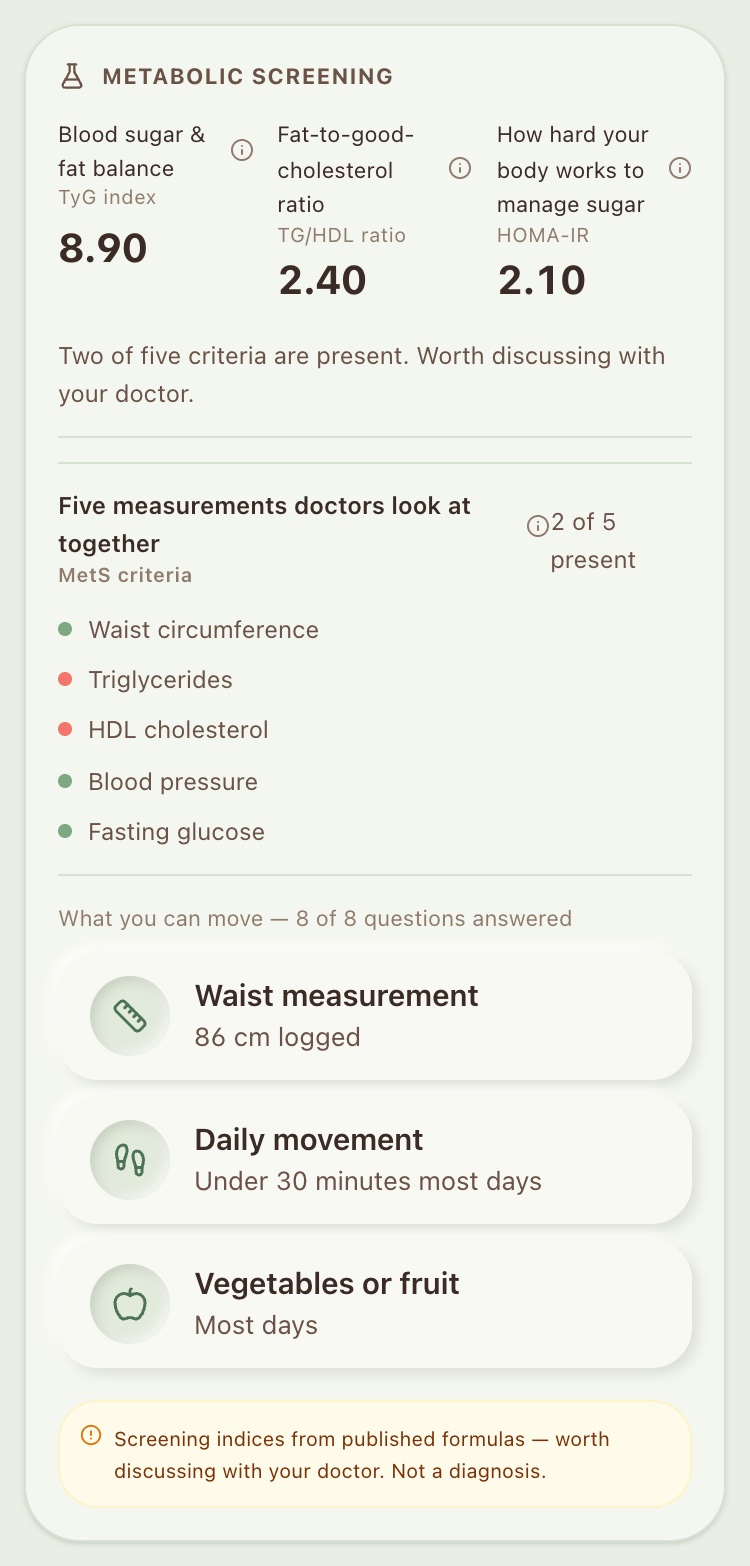
Three of the eight questions are about things you can change: waist circumference, daily activity, and daily vegetables or fruit. AuraShield deliberately shows these three as levers rather than shouting the total score at you. A number you cannot act on is anxiety; a lever is a plan. If your waist has not been measured, the app says not measured yet and lets you log it; if activity is under thirty minutes most days, it says so in those words.
Putting the screen next to your labs
The questionnaire is most useful in combination. If you already have a panel with fasting glucose and triglycerides, AuraShield computes the TyG index and, with fasting insulin, HOMA-IR — how to read the labs you already have — and shows how many of the five metabolic-syndrome criteria it can measure. The FINDRISC band sits beside them as context, not as a fifth number to worry about. Together they answer a simple question: is this worth a proper look?
For anyone who menstruates, the read is made in the context of the cycle rather than against a flat average, because appetite, glucose and energy move across it — why cycle and metabolism belong in one view.
How AuraShield does this
- A two-minute questionnaire in the metabolic screening card, scored by the published FINDRISC rules, shown as a band and three levers.
- Metabolic indices from labs you already have — TyG, TG/HDL, HOMA-IR and the five criteria — with any missing input said out loud.
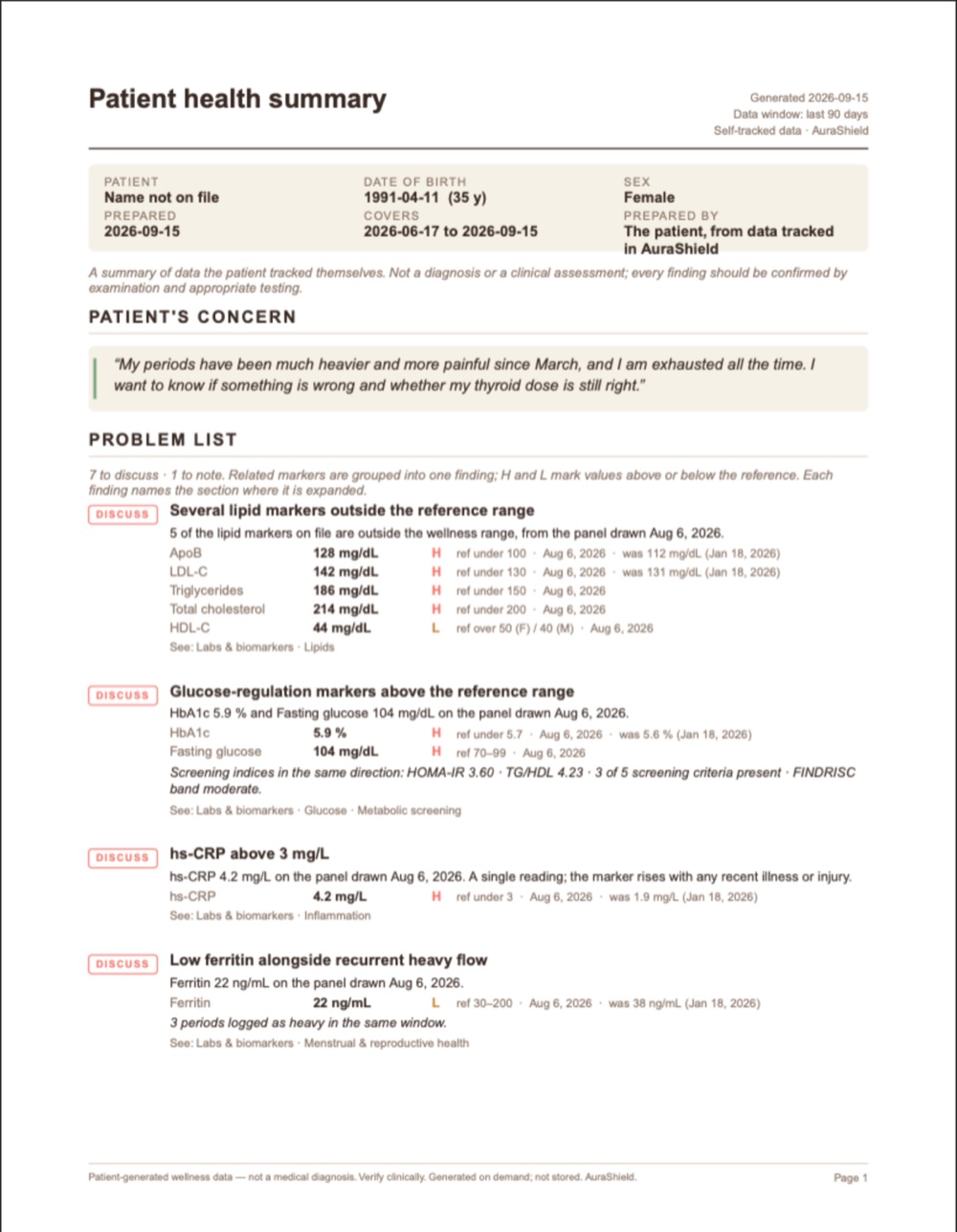
- Every value with its reference and date, and the previous draw beside a repeated marker so a direction reads as a direction.
- All of it on the doctor's report, where a discuss-tier finding names the screening indices that point the same way — what the one-page report contains. Free on every plan.
The reference ranges and the formulas are published on the methodology page, with sources.
What to do with a high band
Ask for a fasting glucose or an HbA1c at your next appointment, and bring the screen with you so the request has a reason behind it. If the lab confirms prediabetes, the good news in the research is consistent: the levers above are exactly the ones that lower the risk of progressing, and a clinician can help you set targets that suit you. The app can keep the numbers organised and show the trend when you repeat the test; it will not tell you what to eat or prescribe anything.
FAQ
Is FINDRISC accurate for people outside Finland?
It has been validated in many populations, and the ranking of risk holds up well; the exact ten-year incidence in each band varies by country and cohort. That is why AuraShield reports a band rather than a percentage.
Can the questionnaire replace a blood test?
No. It tells you whether a blood test is worth asking for. Only a lab result, interpreted by a clinician, can confirm or rule out prediabetes.
How often should I redo it?
The answers that change — waist, activity, diet — are the ones worth updating when they change. Redoing the questionnaire after a real change in habits, or once a year, is a reasonable rhythm; the app keeps the date of your last answers beside the result.
This article is general health information, not medical advice, and AuraShield is a general-wellness product, not a medical device. It screens, educates and refers; it does not diagnose. For anything about your own health, talk to a clinician who can examine you.