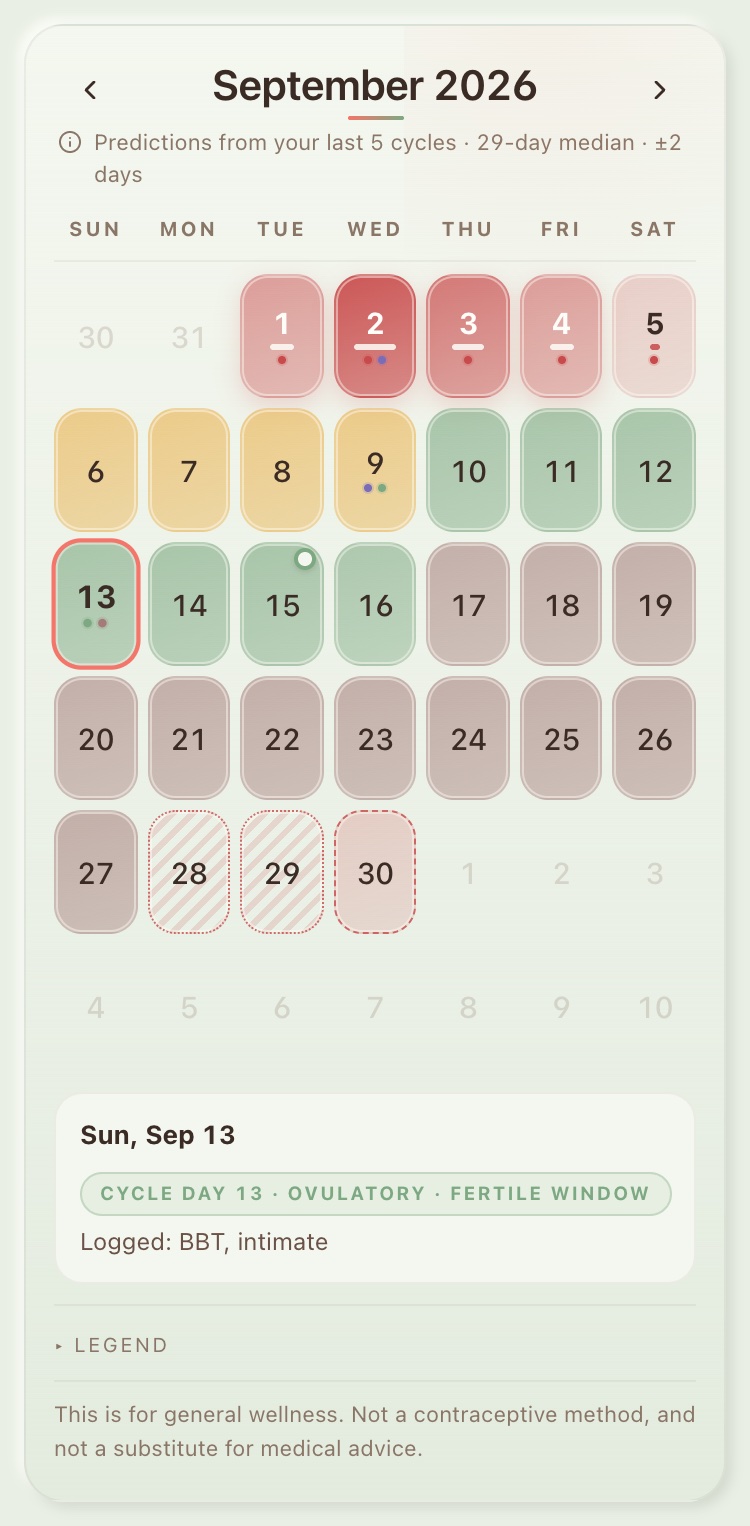
Most health apps score you against a 24-hour body: sleep last night, steps today, a glucose reading this morning, all compared with a flat average of you. If you menstruate, your body does not run on a 24-hour loop. It runs on a longer rhythm — typically somewhere between 24 and 38 days — and appetite, energy, sleep and how your body handles glucose move with it. A cycle-aware view of metabolic health is simply reading those two rhythms together instead of letting one misread the other.
This article explains what changes across the cycle, why an app that ignores it will flag normal weeks as problems, and how AuraShield reads your cycle and your labs in the same view.
What actually changes across a menstrual cycle
The menstrual cycle has two halves separated by ovulation. The first half (the follicular phase, starting with the period) varies a lot in length from cycle to cycle; the second half (the luteal phase, after ovulation) is comparatively stable. A large analysis of more than 600,000 cycles logged by app users found that cycle length varies more than the textbook 28 days suggests, and that most of that variation lives in the follicular phase (Bull et al., 2019). Clinical work on cycle phases points the same way: the luteal phase holds fairly steady while the follicular phase stretches and shortens (Fehring et al., 2006).
That matters for metabolism because the week before a period is hormonally different from the week after it. Many women notice the practical version of this without any lab: hungrier in the days before a period, warmer at night, more tired, a sweeter tooth. Those are not character flaws or "falling off the plan". They are a rhythm.
The point is not that one phase is good and another bad. The point is that a number read without knowing where you are in your cycle is a number without its context.
Why a single-day score gets it wrong
Take a habit-and-nutrition app that compares this week's intake with your average. In the week before a period, intake is often higher than the average of the whole month. The app sees a deviation and nudges you: you're over target, cut back. Nothing in the app knows this is your pattern, repeated every cycle, and that the following week will swing the other way.
The same thing happens with energy and sleep. A recovery score that treats a luteal-phase dip in heart-rate variability as "recovery debt" will tell you to rest when you are simply in the second half of your cycle. Over months, an app that keeps flagging your normal weeks as problems teaches you to distrust either the app or your body. Neither is a good outcome.
What "reading them together" means in practice
There are two honest ways to add cycle context to metabolic data, and AuraShield does both.
Anchor patterns to the periods you actually logged, not to a predicted phase. A predicted phase is an estimate. A logged period is a fact. AuraShield's cycle-metabolic read takes the days before each period you logged and compares them with the rest of your own history: logged intake, energy, mood and, if you track it, glucose. The result is a statement about you — for example, that your logged intake ran higher in the week before your last few periods than your own average — not a claim about what women in general do.
Put the cycle day on every lab draw. A hormone panel drawn on day 3 means something different from one drawn on day 22. When you enter or upload labs, AuraShield records the cycle day of the draw where your logged history supports it, and shows it beside the value. Reproductive hormones without the cycle day are nearly uninterpretable; with it, your clinician can read them at a glance.
The metabolic half of the picture uses published screening formulas on labs you already have — the kind that come back from a routine panel. The five criteria that clinicians use to screen for metabolic syndrome (waist circumference, triglycerides, HDL cholesterol, blood pressure and fasting glucose) come from the harmonised definition published in Circulation (Alberti et al., 2009). AuraShield shows which of the five it can measure from your data, which are present, and which are missing — and never turns that into a diagnosis. Read more in how to read the labs you already have.
How AuraShield does this
- A calendar anchored to your periods. Predictions run three cycles ahead and show their confidence band, which widens the further out they go. Why a prediction should show how sure it is.
- Metabolic screening from a panel you already have: TyG index, TG/HDL, HOMA-IR and the five criteria, plus a two-minute questionnaire when you have no bloodwork yet.
- The cycle-metabolic read: the week before each logged period against your own average, for intake, energy, mood and glucose.
- Hormone labs with the cycle day of the draw, on the same timeline as everything else.
- A doctor's report that puts all of it on one page a clinician can read in a minute — what the report contains. It is free on every plan.
Everything above is on the free plan. Your cycle data is encrypted field by field, and our cycle-data policy is public.
What this is not
AuraShield screens, educates and refers. It does not diagnose polycystic ovary syndrome, perimenopause, insulin resistance or anything else, and a pattern in your own data is a reason to ask a clinician a better question — not an answer. If your cycles regularly fall outside 24–38 days, vary by more than about a week, or you have gone 90 days without a period, that is worth a conversation with a clinician in its own right (FIGO's definitions of normal and abnormal bleeding are the reference here: Munro et al., 2018).
FAQ
Do I need lab results to use the cycle-aware view?
No. The cycle-metabolic read works from what you log — periods, meals, energy, mood. Labs add the metabolic screening layer when you have them; a two-minute questionnaire gives a first read when you don't.
Does AuraShield predict my phase and then judge my data against it?
No. Patterns are anchored to the periods you logged, which are facts, rather than to a predicted phase, which is an estimate. Predictions are shown separately, with their confidence band.
Is this useful if my cycles are irregular?
Yes, with one honest caveat: the fewer regular cycles you have logged, the wider the prediction bands will be, and the app says so rather than pretending. The cycle-metabolic read still works because it uses logged periods, not predictions.
This article is general health information, not medical advice, and AuraShield is a general-wellness product, not a medical device. It screens, educates and refers; it does not diagnose. For anything about your own health, talk to a clinician who can examine you.