Cycles that used to arrive every 28 days now come at 24, then 35, then not at all for two months. Nights are warmer. Sleep is worse. You search perimenopause symptoms and find a list that could describe half the adults you know. Perimenopause is one explanation. Thyroid changes, iron deficiency, stress, a change in medication and several other things can produce an overlapping picture — and the thing that separates them is not a single hormone test but a careful history. That history is something you can build before the appointment.
This article explains how perimenopause is actually identified, why a one-off hormone test rarely settles it, and what to track so your doctor's report starts the conversation from evidence.
How clinicians actually identify perimenopause
The stage before the final menstrual period is defined by the pattern of cycles, not by a lab value. The international staging system used in research — STRAW+10 — marks early perimenopause by cycles that have become persistently irregular, with a cycle-to-cycle difference of seven days or more, and late perimenopause by gaps of sixty days or more between periods (Harlow et al., 2012).
Clinical guidance follows the same logic. The UK's NICE guideline says perimenopause can be diagnosed in women over 45 on the basis of symptoms and cycle changes alone, without a blood test; a hormone test may be considered between 40 and 45 when symptoms are present, and is recommended under 40 because an early change needs a different work-up (NICE NG23). In other words: for most people, the doctor is going to ask about the cycles, the sleep and the flushes — and the more precisely you can answer, the better.
A blood test can be normal on Monday and different on Friday. Six months of logged cycles cannot be argued with.
Why a single FSH result rarely settles it
Follicle-stimulating hormone (FSH) rises as the ovaries respond less, so it is the test people expect. But in perimenopause it swings from cycle to cycle and within a cycle, which is exactly why guidelines lean on the history first. A high FSH on one day is a snapshot; a low one on another does not rule anything out. If a hormone panel is drawn, the cycle day of the draw is the single most important piece of context for reading it — which is why AuraShield records it beside every hormone result.
What else can look like perimenopause
- Thyroid changes — an under- or over-active thyroid can alter cycle length, sleep, weight and mood. A TSH result on your panel, and any thyroid medication you take, belong on the same page as your cycle history.
- Iron deficiency — fatigue and poor concentration alongside heavier periods; see heavy periods and low ferritin.
- Stress, illness and weight change — all of which can lengthen or skip cycles for a while.
- Medication changes, including starting or stopping hormonal contraception.
- Pregnancy — a skipped period in someone still cycling is still a skipped period.
None of these are things an app can distinguish. All of them are things a clinician distinguishes faster when the history is in front of them.
What to track, and for how long
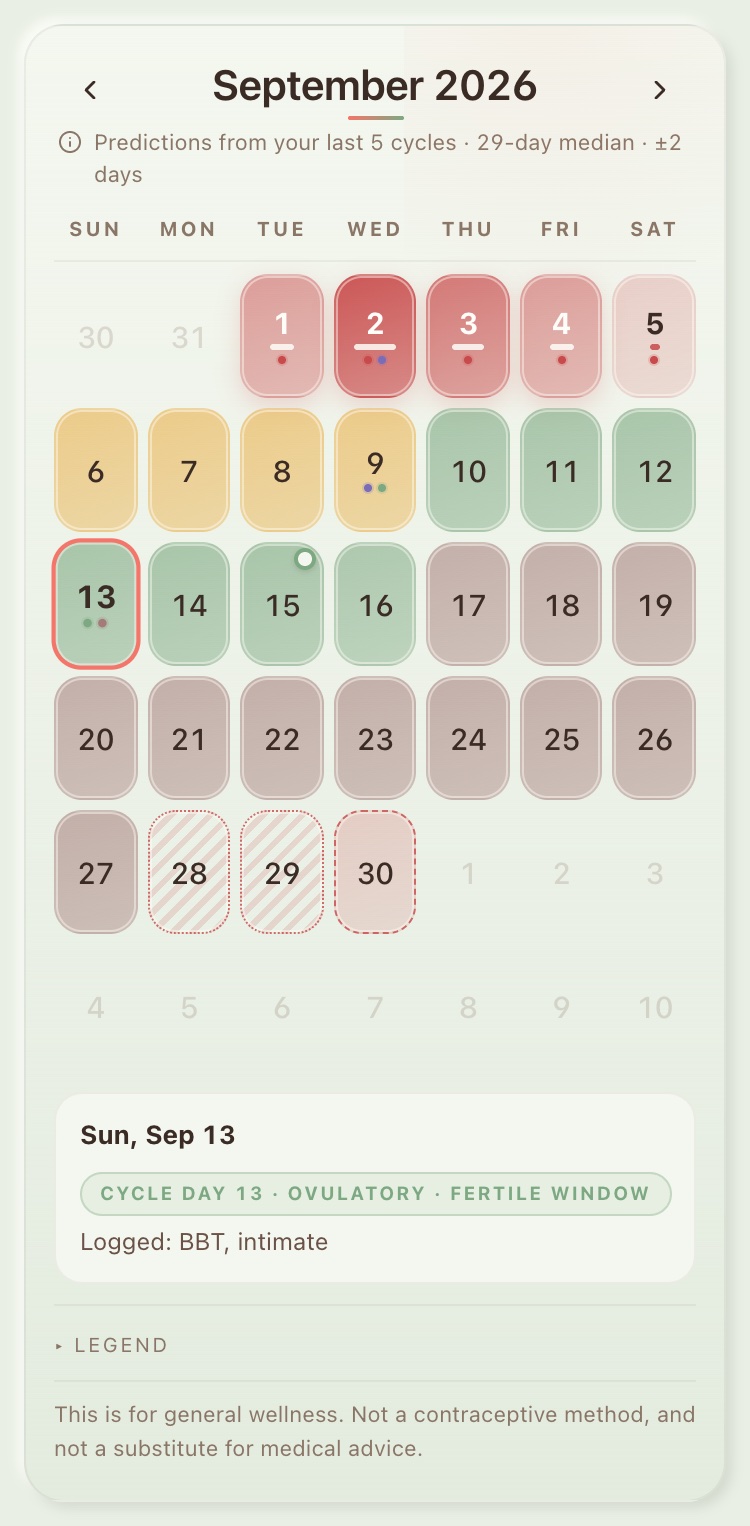
Cycles. Start and end dates, and flow. The number a clinician wants is not "irregular" but how irregular: the range of your cycle lengths over the last six or twelve months, and the longest gap. In the largest published dataset of logged cycles, cycle length varies far more than the textbook suggests even in the years before perimenopause (Bull et al., 2019), so a real baseline is what makes a change visible. FIGO treats a cycle-to-cycle variation of more than seven to nine days as outside the normal range (Munro et al., 2018).
Symptoms, with dates. Hot flushes, night sweats, sleep disruption, mood changes, brain fog, joint aches — logged on the day they happen, so they can be counted by cycle phase rather than remembered as "a lot lately". A flush pattern that clusters in the days before a period reads differently from one spread across the month.
Sleep. Nights woken, and whether a night sweat was the reason.
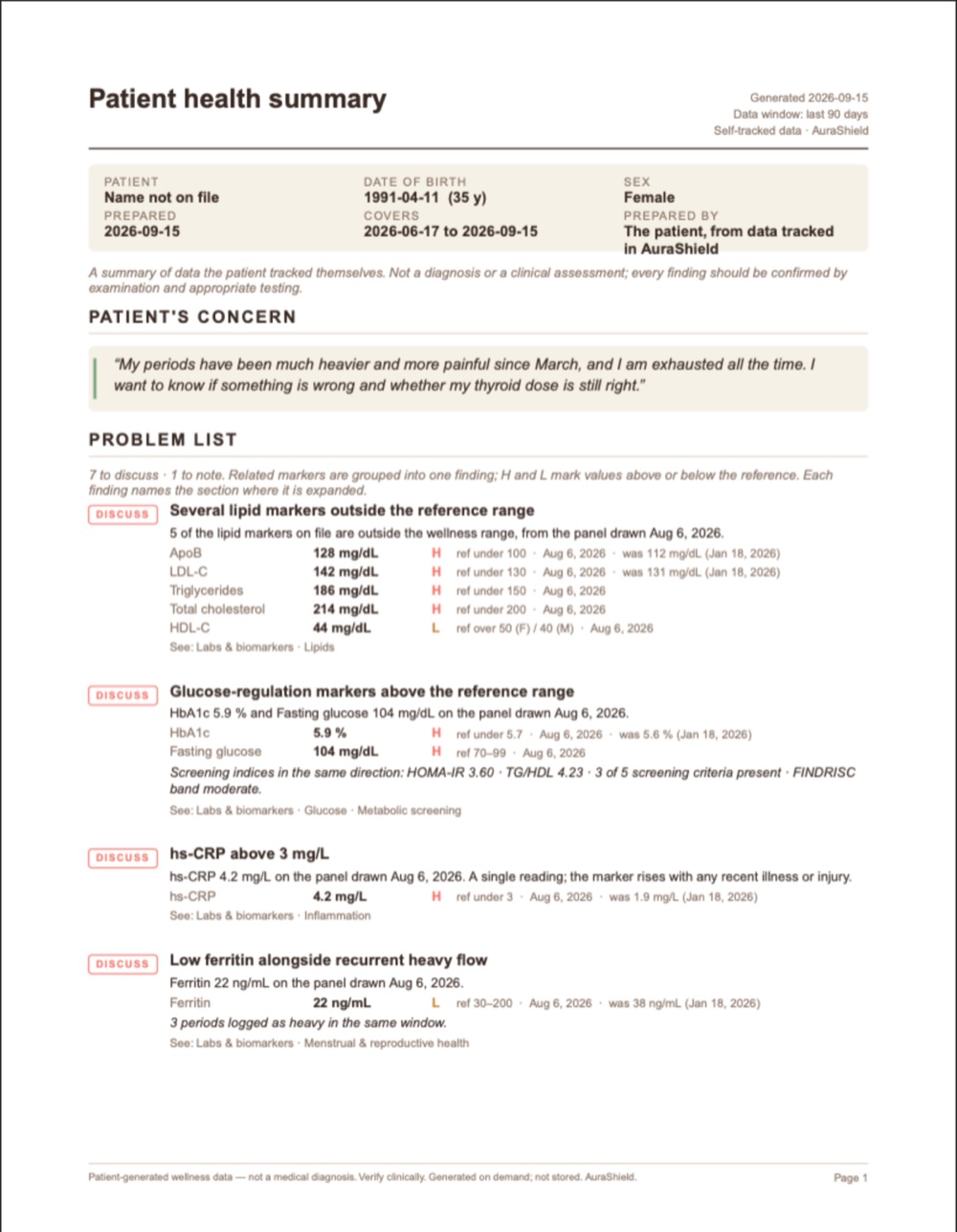
Labs, if you have them. TSH, ferritin, a lipid panel, HbA1c — and any reproductive hormones with the cycle day of the draw. Midlife is also when cardiometabolic risk shifts, so the same page that carries your cycle history can carry the labs you already have.
Medications and supplements, with doses and what they are for — the second thing a clinician reads after your concern.
How AuraShield does this
- The cycle calendar keeps every logged period and shows your cycle-length range and spread — the exact numbers the STRAW+10 and NICE criteria are built on — and pauses predictions rather than inventing a phase when a period is late.
- Symptoms are counted by phase, so "night sweats, mostly in the week before a period" is a line on your report, not a memory.
- Hormone labs carry the cycle day of the draw; TSH and ferritin sit in their own panels with reference ranges.
- The doctor's report puts your concern first — "my cycles have been all over the place since spring and I'm not sleeping" — followed by the cycle history, any cycle findings, medications, allergies and labs on one page. What the one-page report contains. It is free on every plan.
- It never names perimenopause. The app screens, educates and refers; the report shows the pattern and leaves the word to the clinician.
Your cycle data is encrypted field by field, and our cycle-data policy is public.
When to go sooner
Bleeding after a year without periods, bleeding after sex, periods that are suddenly very heavy or last more than eight days, or cycle changes before 40 are all reasons to book an appointment now rather than to track for six months first.
FAQ
Can the app tell me whether I am in perimenopause?
No, and it will not try. Perimenopause is identified by a clinician from your history and, in some cases, tests. The app makes that history precise — cycle lengths and gaps, symptoms by phase, labs with their dates — and puts it on one page.
Do I need hormone tests before the appointment?
Usually not, especially over 45: guidelines base the diagnosis on symptoms and cycle changes. If you already have results, enter them with the date; the cycle day of the draw is recorded, which is what makes them interpretable.
How long should I track before it is useful?
Three logged cycles give the calendar a personal median; six to twelve months give a clinician the range and the longest gap they will ask about. Start now either way — the report is useful with whatever you have, and it says how much that is.
This article is general health information, not medical advice, and AuraShield is a general-wellness product, not a medical device. It screens, educates and refers; it does not diagnose. For anything about your own health, talk to a clinician who can examine you.